

Automation for Small Businesses: Saving Time, Growing, and Peace of Mind
I doubt as a business owner you’ve ever said: “Oh, I have so much free time!” Right? Most small business owners I meet are the exact opposite: tons of tasks, little time, and often even less money for a marketing team or an assistant. But what if I told you there’s a secret weapon that can help you reclaim your time, reduce stress, and boost profits in the process?
This secret is automation. In our previous article, we already touched upon the importance of time management. Now, let’s dive deeper into the world of automation tools that can not only save you time and money but also take your business to the next level. Think about how much time you would free up if bookings, invoicing, and parts of your marketing ran automatically? You could dedicate this time to developing new products, training your team, resting, or even spending time with your family!
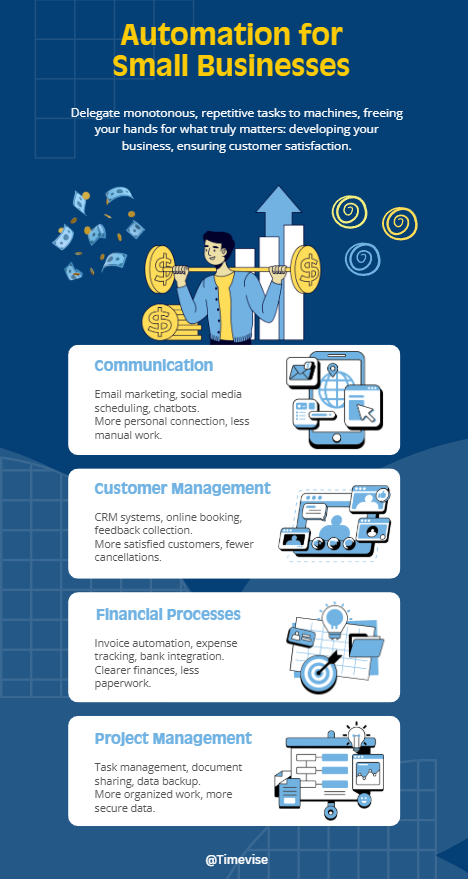
tl;dr – The Essence in Brief
Automate your business in 4 key areas for success:
-
Communication: Email marketing, social media scheduling, chatbots – more personal connection, less manual work.
-
Customer Management: CRM systems, online booking, feedback collection – more satisfied customers, fewer cancellations.
-
Financial Processes: Invoice automation, expense tracking, bank integration – clearer finances, less paperwork.
-
Project Management & Others: Task management, document sharing, data backup – more organized work, more secure data.
Some proven tools to get you started: Mailchimp (email), Hootsuite (social media), HubSpot (CRM), Trello (projects), Timevise (appointment booking).
1. Automating Communication: Building Relationships Around the Clock
Many are afraid that automation will remove the personal touch from communication. On the contrary! By automating routine tasks, you have more time for truly personal interactions, deeper conversations, and more personalized services. Think about how much time you spend daily writing emails, scheduling appointments, or manually posting on social media? These can all be automated, allowing you to focus on revenue-generating, strategic activities.
Moreover, automating communication presents a more professional image. Automatic replies, scheduled posts, and chatbots convey that your customers are important and can always count on you. You can reduce errors and delays, significantly increasing customer satisfaction and trust.
1.1. Automating Email Marketing: Personal Messages at Scale
Email marketing remains one of the most effective ways to stay in touch with customers and drive sales. But imagine not having to send every single message manually!
Newsletters and Welcome Series
With newsletters, you can inform your customers about news, promotions, or provide useful tips. Mailchimp and Sendinblue (now Brevo) are great tools for this, with both free and paid options. Imagine automatically sending a warm welcome email to every new subscriber, or a reminder about an upcoming appointment! These automatisms build relationships without you having to write and send each message.
Which one to choose? Mailchimp, with its user-friendly interface and generous free plan, is excellent for beginners, while Sendinblue offers more complex automation workflows and transactional emails for when you move to a more advanced level.
How to write a marketing email?
Artificial intelligence now offers a lot of help with copywriting. With a good prompt, ChatGPT or Claude can create a pretty good newsletter draft, and the free version’s daily limit is sure to accommodate at least one finished piece. If you want to go even further, our AI-powered blog and newsletter writing application, Timevise Marketing, helps you quickly create professional, targeted content, ensuring you always send fresh and relevant messages to your customers. By saving you time and removing the burden of content creation, you can finally focus on what truly brings in revenue: your customers.
👉 See how to use email marketing effectively on a low budget!
Segmented Campaigns: Targeted Offers
With segmented campaigns, you can make your communication even more personalized. For example, you can create an automatic campaign for your loyal customers with exclusive offers. Or another one for those who haven’t purchased in a while, to re-engage their interest with a special offer. Mailchimp and Sendinblue allow you to segment customers (e.g., based on purchasing habits, demographics) and create automated messages tailored to these segments. This not only increases engagement but also improves conversion rates, as the right message reaches the right person at the right time.
1.2. Social Media Management: Active Presence Without Time Commitment
Social media is essential for promoting your business, but regular posting and managing interactions can be time-consuming. Automation comes to your aid here too.
Scheduling Posts
With Hootsuite, Buffer, and Later, you can plan and schedule your posts across multiple platforms in advance. Imagine sitting down on a Sunday afternoon, writing your posts for the next week, and the software automatically publishing them at the best times! This not only saves time but also ensures a consistent online presence, which is crucial for brand building.
Tip: Start with a free version like Buffer to get acquainted with the features, then upgrade to a paid plan if you need more platforms or complex scheduling.
👉 Discover comprehensive social media strategies that work perfectly with automation tools!
Post Content
You can again use AI-powered tools to help with your post content. You can also find free-to-use images relatively easily. If you want to automate content creation, Timevise Marketing generates relevant, attention-grabbing posts for you in moments. The content aligns with your business’s voice, your ideal customers’ interests, and your previously sent newsletters. This is why they bring in more visitors and potential buyers.
Automatic Replies: Quick Response, Satisfied Customers
With automatic replies, you can respond quickly and efficiently to frequently asked questions on your social media feed or in private messages. For example, you can set up a “Thank you for your message, we’ll reply soon!” message outside of business hours, or a link to an FAQ for the most common questions. This saves you time, and your customers will be more satisfied because they receive immediate feedback.
1.3. Chatbot Integration: Customer Service 24/7
Chatbots are revolutionizing customer service, especially for small businesses that may not always have the capacity for a dedicated customer service team.
Non-stop Availability and Quick Answers
With chatbots, you can provide 24/7 customer service on your website or social media platforms. With Chatfuel and ManyChat, you can easily create chatbots that automatically answer common questions, book appointments, or provide basic product information. Your customers can ask their questions anytime, anywhere, and get immediate answers without waiting! This is a huge advantage over competitors and significantly improves the customer experience.
Appointment Booking and Information Provision
Chatbots don’t just answer questions; they can also handle more complex tasks, such as booking appointments or providing detailed product information. This is particularly useful if you have many appointments to schedule (e.g., beauty salon, doctor’s office, consultant) or if you receive many inquiries about your products/services. A chatbot effectively filters inquiries and directs only truly complex cases to you.
2. Automating Customer Management: Satisfied Customers, Long-Term Relationships

Automating customer management helps you understand your customers better and provide more personalized services. You can track your interactions, set reminders, and automatically request feedback. All of this contributes to more satisfied and loyal customers, which increases your revenue in the long run. With automation, you can achieve all of this more efficiently and easily than you might think.
2.1. CRM Systems: All Customer Data in One Place
CRM (Customer Relationship Management) systems are the backbone of managing customer relationships. Without them, information can easily get lost, and personalized communication becomes cumbersome.
Centralizing Customer Data and Managing Sales Processes
With CRM systems, you can centralize all your customer data and track all interactions – whether it’s an email, phone call, purchase, or even a social media message. HubSpot CRM (which has a free version) and Zoho CRM are great tools for this. Imagine having all the information about each customer in one place: their name, address, purchasing habits, past interactions, and even their birthday! This allows you to approach them with personalized offers or recall past conversations, which is a huge advantage in relationship building.
Logging Interactions and Setting Reminders
CRM systems allow for detailed logging of interactions. This helps you understand your customers better and provide more personalized services. You can set reminders so you don’t forget to call customers after a certain period, or remind them of their upcoming appointments. For example, a massage therapist can set the system to automatically send a reminder to the client after 6 weeks that it’s time for another treatment. This is proactive customer management at its finest!
2.2. Automating Appointment Booking: Never Miss a Call Again
Appointment booking can be one of the biggest time-wasters for small businesses. Phone calls, email exchanges, calendar coordination – all of this consumes a lot of energy that could be better spent.
Minimizing Phone Calls and 24/7 Availability
Automating appointment booking helps minimize phone calls and emails. You can use tools like Calendly, Acuity Scheduling, or our own solution, Timevise. With Timevise, you can easily integrate the booking system into your website, Facebook page, or even Instagram profile, and automatically send reminders to your clients.
Why Timevise? While Calendly and Acuity Scheduling are great general-purpose tools, Timevise focuses on the specific needs of small businesses. It provides a simple, intuitive interface, multi-language support, and features like flexible service management, online payment integration, and automatic reminders designed to minimize cancellations. Imagine a hair salon where clients book appointments themselves day and night, and the system automatically sends them SMS or email reminders before their meeting. This not only saves time but also significantly reduces the number of missed appointments!
👉 See how to reduce no-shows with automated systems!
2.3. Collecting Feedback Automatically: Developing in Tune with Customer Voice
Customer feedback is golden, but collecting it manually can be extremely time-consuming. Automation helps here too!
Customer Reviews and Surveys
Collecting feedback automatically helps improve your services and products. You can use tools like Typeform or Google Forms to automatically send out a survey after a service is used or a purchase is made. A gym, for example, can set up an automatic survey for every new member after 30 days about their satisfaction and areas for improvement. This not only improves service quality but also makes customers feel their opinion matters.
Tip: Integrate feedback collection into your CRM system so that past reviews are visible in the customer’s profile, allowing you to provide even more personalized service in the future.
👉 Discover how online reviews can be your secret weapon for business growth!
3. Automating Financial Processes: Order in the Wallet, Peace in the Soul

Managing finances is a bugbear for many small business owners. Invoicing, expense tracking, accounting – all of this takes a lot of time and energy, and it’s easy to make mistakes. Automation is worth its weight in gold here, as it helps save time and energy while ensuring accuracy and transparency. You can quickly and easily issue invoices, track your expenses, and automate transaction recording. All of this contributes to well-managed finances, and you don’t have to spend unnecessary time on accounting tasks. Accurate and up-to-date financial data helps you make informed decisions about your business’s future.
3.1. Automating Invoicing: Speed and Accuracy
Invoicing is one of the most common repetitive tasks that you can easily automate.
Fast Invoice Generation and Recurring Invoices
By automating invoicing, you can generate invoices quickly and easily. You can use tools like FreshBooks or Xero to automatically generate invoices for recurring services (e.g., monthly subscriptions, rental fees) or after successful order completion. A freelance graphic designer, for example, can set it up so that an invoice is automatically generated after each project completion using the client’s data, and perhaps even automatically sent via email.
Which one to choose? Both FreshBooks or Xero are excellent invoicing programs with a wide range of features and legal compliance. It’s worth trying the free version or trial of both to see which interface you prefer and which integrates best with your existing systems.
3.2. Automating Expense Tracking: Always Know What You’re Spending On
Tracking expenses is fundamental to financial health, but it can be extremely tedious manually.
Smartphone Recording and Automatic Reports
By automating expense tracking, you can keep your costs under control and minimize errors. You can use tools like Koin or Expensify to record expenses with your smartphone – simply by taking a photo of the receipt. This is especially useful if you travel a lot or have many small expenses. The software automatically recognizes relevant data from the receipt, categorizes expenses, and generates reports that you can easily send to your accountant. This way, you don’t have to deal with a pile of papers at the end of the month, and you’ll always have an up-to-date picture of your expenses.
3.3. Bank Integration: Seamless Accounting
Bank integration is the next level of financial automation, significantly speeding up accounting processes.
Automatic Transaction Recording
Bank integration helps automate transaction recording in your accounting software. Most modern accounting and invoicing software offers bank integration, allowing for automatic import of bank statements. This means that incoming and outgoing transactions are automatically reflected in your accounting, minimizing manual data entry and potential errors. This also means less work for your accountant, and you get a more accurate picture of your business’s cash flow.
4. Other Useful Automation Tools and Tips

Automation extends beyond communication, customer management, and finances. You can use automation tools in many other areas to increase efficiency and security in your business.
4.1. Project Management Tools: More Organized Work, More Efficient Team
Even in a one-person business, a lot of tasks can pile up, let alone in a small team. Project management tools help manage tasks and teamwork more effectively, even if your team is just you.
You can use tools like Trello, Asana, or Jira (if you have complex tasks) to create projects, assign tasks (even to yourself), set deadlines, and track progress. With these tools, you can make tasks and deadlines more transparent, allowing your team (or yourself) to work more efficiently, and nothing will be missed. Imagine knowing exactly what the top 3 tasks you need to focus on are every morning, instead of spending the first half hour of the morning sifting through your to-do list.
4.2. Document Management and Data Sharing: Order and Security
Managing, storing, and sharing documents often causes headaches. Automated document management brings order to this chaos.
Digitized Storage and Automatic Version Control
Document management helps digitize and automate the storage and management of documents. You can use cloud-based tools like Google Drive, Dropbox, or Microsoft OneDrive to share documents, maintain version control (so you always have access to previous versions), and create automatic backups. This not only saves space but also keeps your documents secure, and you can access them from anywhere.
Sharing Documents and Collaborative Work
Google Drive and Dropbox allow for easy sharing of documents with team members and clients, even with access permission settings. This speeds up collaboration and eliminates the question of “which is the latest version?”
4.3. Automatic Data Backup: Data Secure, Sleep Tight
The nightmare of data loss lurks in every entrepreneur’s mind. A failed hard drive, a virus attack, or even human error can destroy your work. Automatic data backup, however, provides peace of mind.
Securing Data Against Data Loss
Automatic data backup helps secure your data against data loss. You can use cloud-based services like Backblaze or Carbonite to continuously back up your data to the cloud. This means your system constantly monitors your files and immediately saves changes. So, if anything happens, your data is safe and can be easily restored. This is an “invisible” automation whose importance is only truly understood when needed – but then it might be too late to implement.
Related Articles if You Want to Go Further
After successfully implementing your first automation tools, it’s time to build a comprehensive system. Use these strategies to increase your business’s profit and efficiency.
-
Use Free Tools: With these tools, you can easily increase the number of visitors and customers while minimizing costs.
-
Learn about Low-Cost SEO Strategies: Discover SEO techniques that complement your automation systems and drive organic traffic.
-
Appear in ChatGPT Searches: With AI-optimized content, you can increase your visibility and effectively support your automated processes in modern search trends.
-
Write Persuasive Copy: Create website copy that increases conversions and fits perfectly with your automated systems, encouraging customers to act.
-
Develop Your Social Media Marketing: Create automated content that reaches more potential customers and build your community.
Frequently Asked Questions (FAQ) About Automation
1. Is Automation Too Complicated for a Small Business?
Many are concerned that implementing automation is complicated and time-consuming. The truth is, there are many user-friendly tools that you can easily set up with minimal technical knowledge. Start with a single, well-defined task, such as automating email newsletters or appointment booking. By proceeding step by step, you’ll quickly realize that automation saves more time than it takes to implement.
2. Will I Lose Personal Connection with Customers if I Automate?
Quite the opposite! The goal of automation is not depersonalization, but to support the development of more personal relationships. By delegating routine tasks to machines, you free up your time to dedicate to truly deep, value-creating interactions with customers. Think about how much extra time you’ll have for a personal phone call, developing a custom offer, or a longer conversation if you don’t have to manually invoice or schedule appointments.
3. How Much Does Automation Cost? Is It Worth It for a Small Business?
Automation tools range widely in price, from free basic packages to premium, complex solutions. Many of the mentioned tools (e.g., Mailchimp, HubSpot CRM, Google Forms) offer free versions to get you started. The return on investment is almost guaranteed, as automation saves time (which is money), reduces errors, increases customer satisfaction, and boosts efficiency, all of which directly contribute to increased revenue. It’s worth measuring for a day or two which tasks take up the most time, and then choosing the most profitable automation option.
4. Where Should I Start With Automation?
The best approach is to measure for a few days how much time you spend on different tasks. You should first automate what takes up the most of your time or what is the most monotonous. For example, if you schedule many appointments by phone, an online appointment booking system like Timevise can be an excellent starting point. If you send a lot of emails, an email marketing automation tool will be the winner. Start small, measure the results, and gradually expand your automated processes.
Automation: The Key to Success in 2025 and Beyond!

In summary, automation is not a luxury but an essential strategy for any small business looking to grow in today’s rapidly changing world. It helps save time, become more efficient, reduce costs, and increase revenue. If you have a small or micro-business, don’t hesitate to dive in!
As mentioned in the FAQ section, a good method is to measure for a few days how much time you spend on different tasks. You should first automate what takes up the most of your time. Try the tools presented and measure how much you save – this will help you easily decide if a tool is worth the invested money and effort. Remember, the goal is to increase your free time and profit!
We especially recommend trying our appointment booking system, Timevise, as it is specifically tailored to the needs of small businesses and offers numerous advantages over manual or less optimized solutions. Start today and experience the difference!
For more information, visit our website or read our related articles to dive deeper into the world of business automation.
This article was created with the Timevise Marketing tool.